
B Corp, one of the most well-known sustainability certifications, has tightened its standards. Since 2026, companies certify against version 2.1 of the B Lab Standards, which set minimum requirements on climate. What you must do depends on your size: a company with fewer than 250 workers publishes a climate action plan with measurable targets, and a company with 250 or more workers must also measure its scope 1, 2 and 3 emissions every year. In this article, you will discover how to meet these B Corp requirements.
Context: How to become a B Corp?
The B Corp logo is appearing more frequently—on packaging, websites, and company materials. This certification, based on social and environmental standards, is rapidly gaining popularity. The Benelux region now has over 480 B Corps, and globally, there are more than 8,000.
To become B Corp certified, you must meet minimum requirements across seven Impact Topics, checked by an independent third-party audit. Certification runs on a five-year cycle, during which you are expected to keep improving your impact.
Carbon Accounting as the key to B Corp
B Lab, the organization behind B Corp, has raised the standards. It launched the new standards in April 2025, and companies applying from 2026 certify against version 2.1. This article was first written on the draft and was updated to the published standard on 22 November 2026. For the full details, see B Lab's own publication.
A lot is going to change. Meeting the new requirements will be more challenging, but with the right tools, such as Carbon Accounting and the Hedgehog Carbon Platform, it becomes much easier. With Carbon Accounting, you gain control over your emissions, save costs, and effortlessly meet B Corp requirements. Later in this article, you will discover how this works.
What do these changes mean for current B Corps and companies seeking certification?
Two changes in B Corp standards stand out
1. Minimum requirements per Impact Topic
There is no longer one overall score. Instead, you must meet minimum requirements within each individual "Impact Topic."
This prevents weak performance in one area (such as climate) from being compensated by strong performance in another (such as employee well-being). Previously, themes such as diversity and CO₂ reduction were sometimes ignored, but this is no longer possible.
The seven Impact Topics are:
- Purpose and Stakeholder Governance
- Climate Action
- Justice, Equity, Diversity & Inclusion
- Government Affairs and Collective Action
- Fair Work
- Human Rights
- Environmental Stewardship and Circularity
2. Improvement is mandatory
A second interesting change is that you must demonstrate improvements. This ensures that B Corp is not a one-time stamp, but that you continue to improve.
Under the new standards, B Corps are expected to keep improving their impact over the five-year certification cycle. This can be done by setting measurable goals and reporting progress in areas such as CO₂ reduction, diversity & inclusion, or living wages.
With the new standard, you are required to share your progress publicly. This enhances the credibility of B Corps and prevents "greenwashing." If you cannot demonstrate that you have made improvements, the certification may be revoked.
Carbon Accounting and B Corp
Obtaining a B Corp certification requires meeting minimum requirements in various impact areas, including Climate Action. For this topic, every company needs a credible plan to cut its emissions, and companies with 250 or more workers also need measured emissions data.
An effective method to measure and manage consumption and emissions is through Carbon Accounting. This gives you direct insight into your climate impact and allows you to take targeted reduction measures. Additionally, it supports what B Corp asks: measurable reduction targets and transparent reporting on progress, plus measured emissions for companies with 250 or more workers. Two for the price of one!
A detailed explanation of carbon accounting can be found here: Quantifying Sustainability: A Complete Guide to Carbon Accounting
Impact Topic: Climate Action
Let's zoom in on the topic of Climate Action. Previously, this category was often overlooked by companies, partly because collecting and managing the correct emission data is time-consuming. Now that you can no longer "offset" different impact topics against each other, these insights have become an essential part of B Corp certification.
What you must do depends on your size. Micro, small and medium companies (fewer than 250 workers) publish a climate action plan that commits to limiting warming to 1.5°C, with SMART targets, update it every 36 months and, from year three, record their progress each year. B Lab says these companies follow a path that does not rely on precise GHG measurement. Large companies (250 workers or more) must also measure their emissions every year, publish them, have them verified and have their targets validated.
What insights do you need to meet B Corp requirements?
Based on version 2.1 of the B Lab Standards, we outline what the Climate Action topic asks. The first two requirements apply to large companies (250 workers or more); the climate action plan applies to every company.
1. Large companies: annual CO₂ measurement and independent verification
Large companies must measure their emissions every year, using a recognised standard such as the GHG Protocol or ISO 14064-1, divided into three scopes:
- Scope 1: Direct emissions (e.g., fuel consumption).
- Scope 2: Indirect emissions from purchased energy.
- Scope 3: Indirect emissions from the value chain.
What do you need to submit?
- Your total emissions, disclosed publicly every year.
- Scope 2 shown both market-based (supplier-specific) and location-based (grid-average).
- Verification of your annual emissions data by an accredited, independent third party.
How do you comply?
You can use the GHG Protocol or ISO 14064-1. For Scope 3, various methods can be used, such as estimates based on expenditures, average industry values, or data from suppliers. Smaller companies do not have to submit an emissions measurement, but a footprint is still the most practical way to set targets you can track.
2. Large companies: validated reduction targets
Large companies must have their reduction targets validated by the Science Based Targets initiative (SBTi) or verified by an independent, accredited third party.
How do you comply?
Submit your targets to SBTi or an accredited verifier, publish your annual emissions, and show how you are reducing them. B Lab adds that a CDP publication may accompany this disclosure but does not replace it.
3. Every company: a climate action plan with measurable targets
Every company must make a climate action plan publicly accessible. The plan commits to supporting the global ambition to limit warming to 1.5°C and includes SMART targets (specific, measurable, achievable, relevant and time-bound).
How do you comply?
Publish the plan, update it at least every 36 months, and from year three record each year which targets have been met, are in progress or need adjustment.
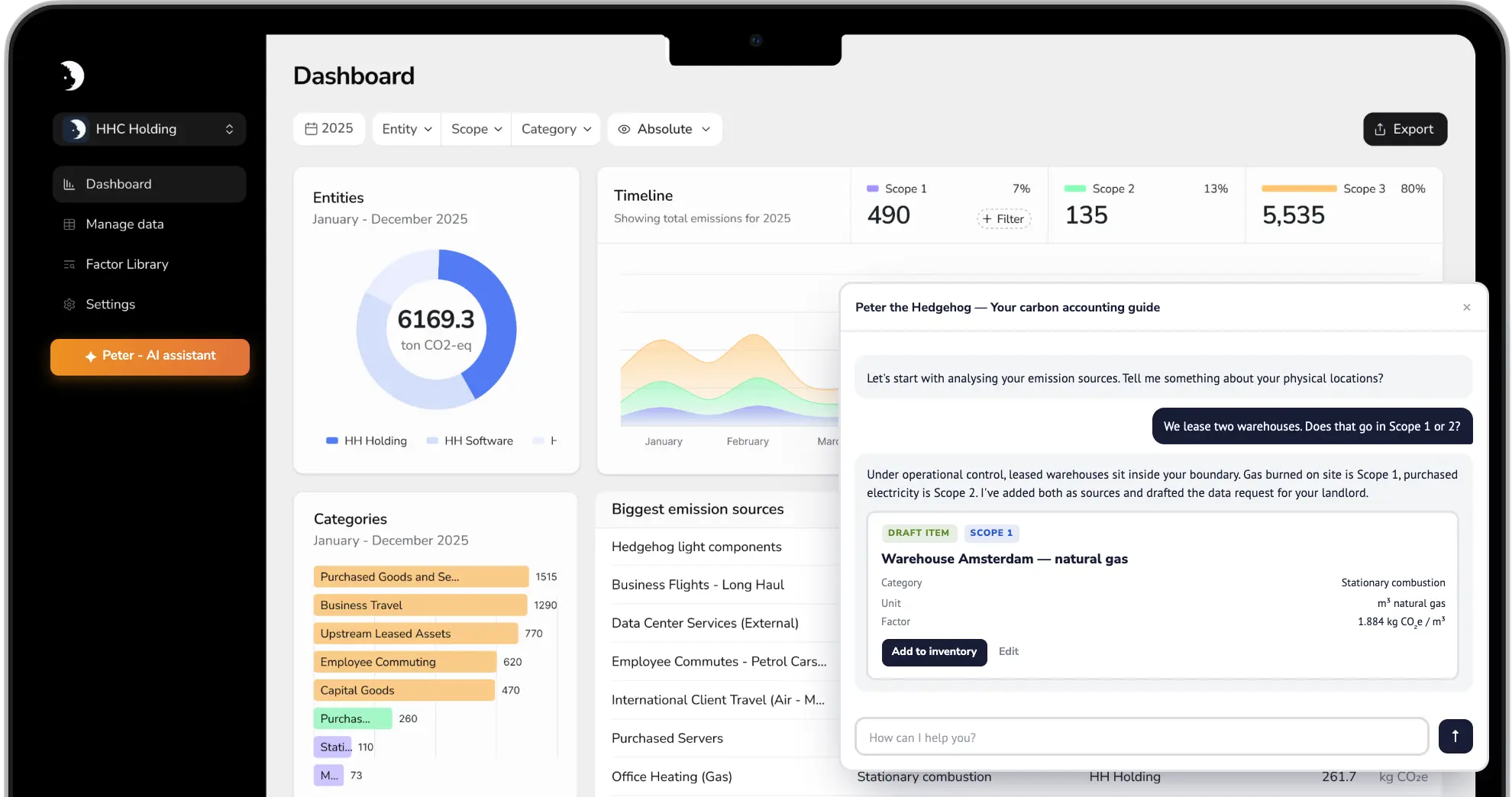
Monitor your own emissions. Use the Hedgehog Carbon Platform
Correctly collecting and managing CO₂ data is a challenge. Where do you get the data from? How do you measure emissions? How do you present the figures clearly? Hedgehog offers a practical solution: the Carbon Platform.
This online platform helps companies measure, manage, and reduce their CO₂ emissions. Whether you are just starting with sustainable entrepreneurship or already have ambitious climate goals, the platform provides the tools and guidance needed to meet B Corp requirements.
What Does the Carbon Platform Offer?
- CO₂ Measurements According to International Standards: Calculate Scope 1, 2, and 3 emissions fully in line with the GHG Protocol.
- Data Analysis and Reduction Strategies: Insight into emission data and recommendations for reduction measures.
- Reporting and Compliance: Complies with CSRD, SBTi, B Corp, and other sustainability standards.
- Smooth Data Collection: Our dynamic platform ensures that you always collect available and relevant data.
- Easy Collaboration: Manage users and grant access to colleagues, accountants, auditors, consultants, etc.
- Carbon Dashboard: Identify CO₂ hotspots and implement reduction measures directly
.
With the free version of the platform, you can easily enter your Scope 1 and 2 emissions and certain Scope 3 emissions (such as business travel and commuting). The pro version offers advanced features and a detailed database for in-depth analyses.
Check out the platform yourself!

Verification
Large companies must have their annual emissions data verified by an accredited, independent third party. Smaller companies do not need verified emissions data; the certification itself is checked by an independent third-party audit.
Hedgehog helps
- Registration with SBTi for B Corp Certification.
- Guidance on Carbon Accounting and Reporting.
This makes it easier to meet the B Corp standard and make a real impact.
Do you want to get started with carbon accounting and prepare for the new B Corp standard? Try the free version of the Hedgehog Carbon Platform and experience the convenience!


